
When we launched After Earnings with Morning Brew in early 2024, the hypothesis was that retail investors deserved the same access to public company leadership that hedge fund managers and sell-side analysts had always enjoyed. That show — which has since featured CFOs and CEOs from Salesforce, Airbnb, Pfizer, Arm, Adobe, Affirm, and dozens more — proved the demand was real. Millions of individual investors wanted to hear directly from the executives behind the tickers they own.
Marketopolis is the another chapter of that playbook.
Produced by Stakeholder Labs, Marketopolis takes the format deeper. Where After Earnings captures the post-quarter narrative — the numbers, the guidance, the forward look — Marketopolis zooms out. Executives open up about how they think about money, investing, and leadership, while also revealing how they communicate with the markets and how they view the growing influence of retail investors.
Fourteen episodes later, the show featured founders, CEOs, and C-suite leaders across fintech, consumer brands, energy infrastructure, real estate, media, bitcoin mining, aviation, and enterprise software.
And while no two conversations were alike, the themes that emerged tell a remarkably consistent story about where the relationship between public companies and their investors is heading.
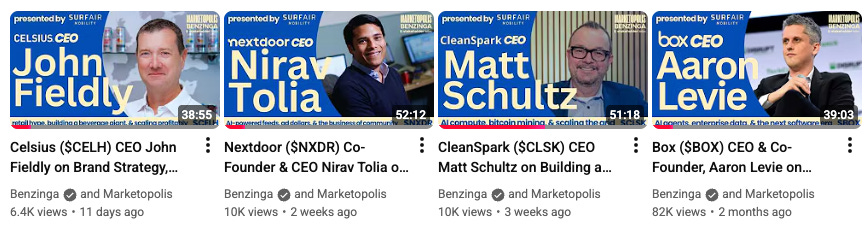
🎙️ Celsius ($CELH) — John Fieldly, Chairman & CEO
John Fieldly walked us through one of the best turnaround stories in consumer packaged goods: taking Celsius from a micro-cap restructuring to a $2.5B revenue energy brand portfolio. With the Alani Nu acquisition expanding Celsius into a multi-brand platform alongside Rockstar, Fieldly broke down the portfolio logic — how each brand extends shelf space, pricing architecture, and retail execution without cannibalizing the others. He also made a compelling case for why the “better-for-you” movement in energy drinks is still in early innings and how Celsius is positioned to capture international growth and new consumption occasions.
Why it matters for Comms & IR: Celsius is a masterclass in narrative evolution. Fieldly didn’t just explain the numbers — he gave investors a framework for understanding why the business model works and where it goes from here. That kind of strategic storytelling is what builds conviction beyond a single quarter. Notably, Fieldly was also one of the very first guests on After Earnings when we launched the show with Morning Brew — a testament to how seriously Celsius takes direct-to-investor communication.
🎙️ Nextdoor ($KIND) — Nirav Tolia, Co-Founder & CEO
Nirav Tolia came back to the CEO seat after Nextdoor’s stock drew down over 90% from its SPAC highs — and he did something most founders in that position don’t do: he addressed it directly. On Marketopolis, Tolia was candid about what went wrong, what’s changed in the post-COVID and AI landscape, and why he believes the company’s core asset — a neighborhood graph of 100M+ verified users tied to real-world locations — is still dramatically undervalued. He detailed how AI is now the operating layer across efficiency, product quality, and local advertising outcomes.
Why it matters for Comms & IR: Tolia addressed the single biggest misconception about Nextdoor head-on: that the opportunity is capped, when in reality, it was under-executed. That kind of radical transparency with investors — especially retail investors who lived through the drawdown — is exactly the type of communication that rebuilds trust.
🎙️ Box ($BOX) — Aaron Levie, CEO & Co-Founder
Aaron Levie is one of enterprise software’s most recognizable CEOs, and his Marketopolis episode was part investing lesson, part AI strategy deep-dive. Levie opened up about his earliest investing mistake — losing his Bar Mitzvah fund on a cable stock — and connected those early lessons to how he thinks about capital allocation and long-term business building today. The core of the conversation was Box’s AI transformation: not a pivot, but a bold expansion of their mission to unlock the hidden value sitting inside enterprise data. Levie was also candid about the challenge of communicating AI’s value to both Wall Street and retail investors in a market flooded with AI narratives.
Why it matters for Comms & IR: When every company claims to be “AI-first,” Levie demonstrated what it looks like to actually articulate the differentiation. He framed AI not as a feature set but as an unlock for Box’s entire value proposition — the kind of strategic framing that helps investors separate signal from noise.
🎙️ CleanSpark ($CLSK) — Matt Schultz, CEO & Chairman
Matt Schultz traces CleanSpark’s evolution from gasification technology to Bitcoin mining to what he now calls a “monetize megawatts” platform spanning Bitcoin and AI/HPC compute. Schultz explained how selling Bitcoin at the 2022 peak and reinvesting into infrastructure — while peers were leveraging up — created a structural advantage that’s now paying off as the company expands into long-term AI data center contracts. He also addressed common retail investor misconceptions around execution timelines and shareholder alignment, making the case that Bitcoin mining and AI compute aren’t competing strategies but complementary uses of the same energy infrastructure.
Why it matters for Comms & IR: CleanSpark sits at the intersection of three of the hottest retail investor narratives — Bitcoin, AI, and energy infrastructure. Schultz used the conversation to simplify a complex thesis and give investors a clear mental model, which is exactly what companies in emerging categories need to do to build a durable shareholder base.
🎙️ Webull ($BULL) — Anthony Denier, CEO
Recorded live at Benzinga Fintech Day, Anthony Denier sat down to discuss how Webull is building the infrastructure for the next era of retail investing. Denier detailed the launch of Vega, Webull’s AI-powered platform for personalized trading insights, and explained the company’s expansion across 14 global markets. But what made the conversation stand out was Denier’s perspective on the evolving retail investor: not a meme-stock caricature, but an increasingly data-savvy and selective capital allocator. He also spoke directly about the importance of building infrastructure that connects public companies with their retail shareholders — a topic that couldn’t be more aligned with the mission behind Marketopolis.
Why it matters for Comms & IR: Webull is both a distribution platform and a bellwether for how retail investors consume information. Denier’s insight that retail is getting smarter, not louder should reshape how IR teams think about the content they create and where they distribute it.
🎙️ Dave ($DAVE) — Jason Wilk, CEO & Kyle Beilman, CFO/COO
This was the only episode in Season 1 to feature a CEO and CFO side by side, and the dual perspective made it one of the most tactically useful conversations of the season. Wilk and Beilman broke down how Dave wins by leading with short-term credit, using real cash-flow data instead of FICO scores, and keeping distribution open so customers don’t have to switch banks. But the real gold was their public company playbook: crisp three-point narratives, conservative guidance designed to build trust over time, and an operating cadence that keeps IR and execution tightly in sync.
Why it matters for Comms & IR: Dave is serving 12 million consumers — many of whom are also investors in the company. Wilk and Beilman offered one of the clearest frameworks we’ve heard for how management teams should think about the feedback loop between product users and shareholders. For any company with a consumer-facing product and a retail shareholder base, this episode is a blueprint.
The Full Season 1 Roster
Beyond the six spotlights above, Season 1 also featured:
George Arison, CEO — Grindr ($GRND) · Shawn David Nelson, CEO & Founder — Lovesac ($LOVE) · Paul Edmondson, CEO — The Arena Group ($AREN) · Matt Meeker, CEO & Co-Founder — BARK ($BARK) · Jason Vieth, CEO — Laird Superfood ($LSF) · Smriti Popenoe, Co-CEO & President — Dynex Capital ($DX) · Mike Logozzo, CEO — reAlpha · Sudhin Shahani, Co-Founder — Surf Air Mobility ($SRFM)
Three Themes That Defined the Season
AI is reshaping every business — and every investor conversation. If there was a single through-line across all fourteen episodes, it was artificial intelligence. But not in the way most people discuss it on social media. Levie described rebuilding Box’s product around AI. Tolia returned to the Nextdoor CEO seat and immediately deployed AI as the operating layer. Denier at Webull talked about AI-powered investor insights through Vega. Schultz at CleanSpark framed energy infrastructure as the connective tissue between crypto and compute. Even Wilk and Beilman at Dave described how cash-flow AI underwriting is the moat that FICO-dependent competitors can’t replicate. The takeaway for IR and comms teams: AI isn’t a talking point to bolt onto your investor deck. It’s a strategic lens that investors — retail and institutional alike — are now evaluating every company through. If you aren’t articulating how AI affects your business model, your competitive moat, or your cost structure, someone else (or something else) will fill that narrative gap for you.
Founders and CEOs are telling personal stories — on purpose. One of the most striking patterns was how personal these executives were willing to get. Nelson traced Lovesac from a college basement to a billion-dollar public company. Meeker explained how an obsession with dogs became the foundation for BARK’s product strategy. Fieldly walked through Celsius’s transformation from turnaround story to multi-brand platform. Levie opened with his Bar Mitzvah investing disaster. These aren’t accidental anecdotes. In a market flooded with information, the executives who break through are the ones who give investors a reason to care beyond the numbers. Origin stories, leadership philosophy, the “why behind the what” — this is the kind of narrative texture that builds long-term shareholder conviction. It’s also the kind of content that performs exceptionally well in generative search environments, where AI systems increasingly summarize companies for investors before they ever visit an IR site.
Retail investors are no longer a side audience. Nearly every guest acknowledged a fundamental shift: retail investors are a permanent, influential force in capital markets. Popenoe at Dynex Capital spoke about how ethical stewardship builds trust with individual shareholders. Denier at Webull described an investor base that’s growing more sophisticated by the quarter. Wilk and Beilman at Dave are building for 12 million consumers who are also potential shareholders. This isn’t news to readers of this newsletter. But hearing it directly from the executives — across wildly different sectors — reinforces a point we’ve been making for years: companies that treat retail investors as a strategic constituency, not an afterthought, will have a structural advantage in how they’re discovered, understood, and valued.
From After Earnings to Marketopolis: Building the Playbook
When we launched After Earnings with Morning Brew in 2024, it represented a thesis put into practice: public company executives should be having conversations with the modern investor, not just the institutional ones. Morning Brew brought massive distribution and an audience of millions of business-minded consumers. The show quickly became a destination for companies looking to connect with a new generation of shareholders — featuring leaders from Salesforce, Airbnb, Pfizer, Affirm, and many more.
Marketopolis builds on that foundation, the show goes deeper on strategy, leadership, and the personal side of running a public company. After Earnings captures the post-quarter narrative. Marketopolis captures the long-term thesis. Together, they form a media strategy designed to give public companies authentic access to the investors who are actually making decisions.
That’s what makes this more than a podcast. It’s a proof of concept for a new kind of investor engagement — one that meets shareholders where they are, in the formats they trust, with the depth they’re looking for.
What’s Next
Season 2 of Marketopolis is now in production, with new episodes dropping weekly on YouTube, Spotify, Apple Podcasts, and all major platforms. Expect more CEOs, deeper conversations, and continued focus on the intersection of leadership, markets, and the retail investor movement.
If you’re an executive or IR team interested in joining the show, reach out at bookings@farsight-group.com or fill out this form.

Stakeholder Labs
Stakeholder Labs helps public companies build narrative strategy, drive market awareness, and engage the next generation of investors. Marketopolis is produced by Stakeholder Labs. After Earnings is produced by Stakeholder Labs in partnership with Morning Brew.